Improving Representation of Cloud and Precipitation Processes
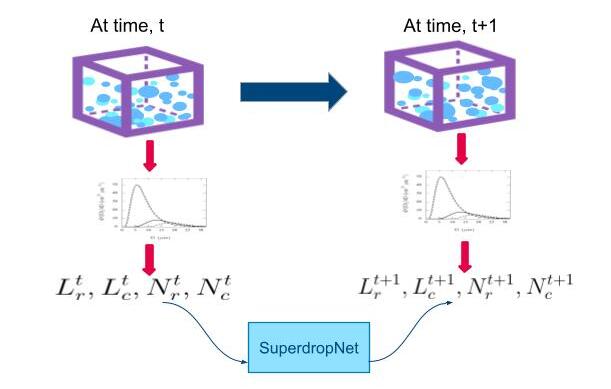 SuperdropNet integrates warm rain collision forward in time, learning from distributions generated using a Lagrangian droplet scheme.
Processes related to cloud formation are heavily parameterized. These processes add to model uncertainity and inaccurate weather forecasts. These processes also contribute to a large uncetainity in climate projections due to its effect on the radiative balance. We can leverage our understanding of these processes to train data-driven models, which act as a computationally cheaper proxy to particle-based simulations. During my PhD, I developed SuperdropNet, trained on Lagrangian superdroplet simulations of warm rain collisions. SuperdropNet is orders of magnitude faster than Lagrangian simulations and is one step closer to more realistic representation of cloud processes in the ICON weather model.
Physics-Informed Machine Learning
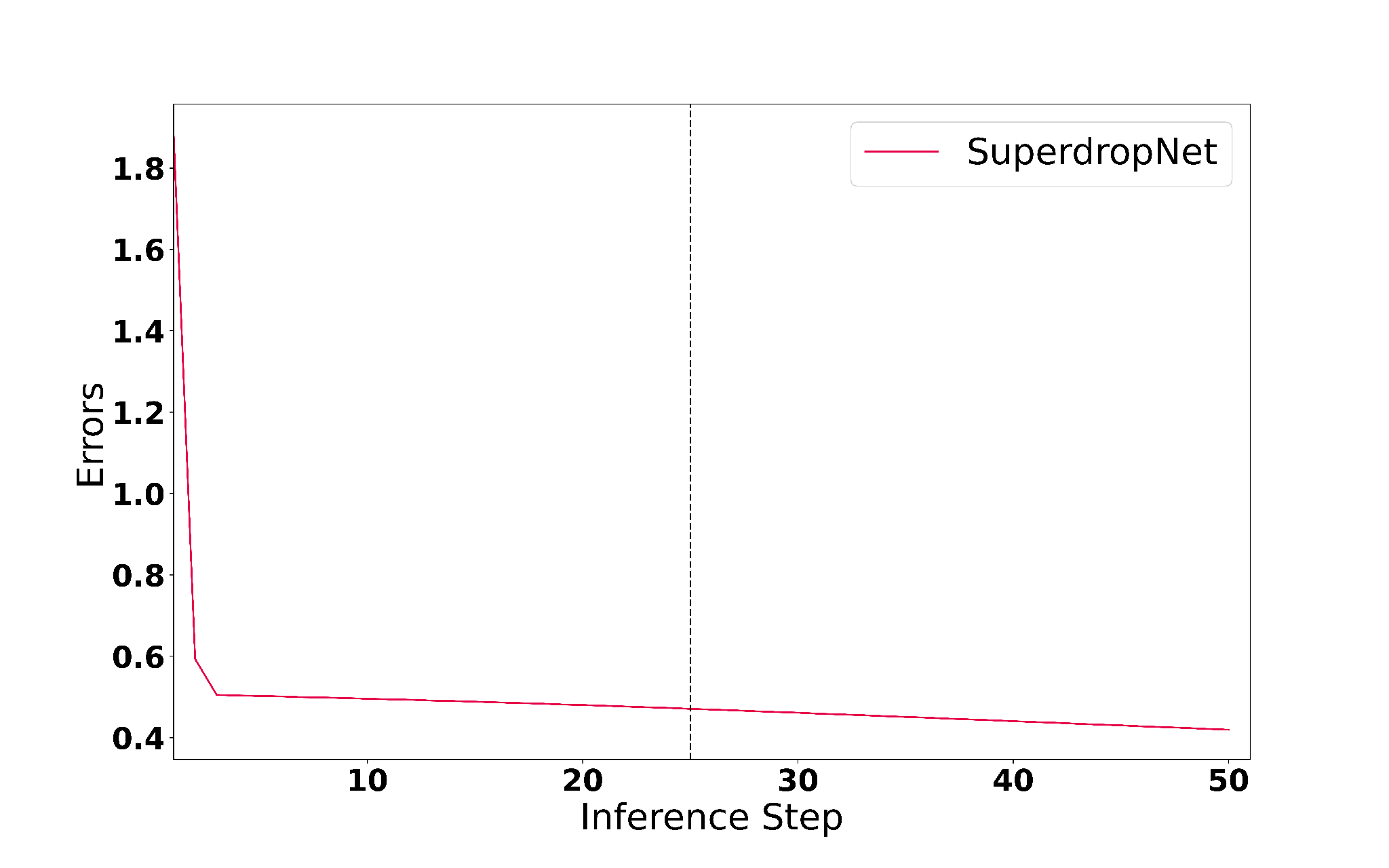 SuperdropNet is a dynamically stable emulator where the errors don’t accumulate over time.
Machine learning based approaches in Earth Science benefit from application of physical contraints based on conservation laws. To ensure stability of simulations and even enhance interpretability, deep learning methods can be nudged using our knwoledge of physics of the problem at hand. SuperdropNet benefitted from autoregressive training, curriculum learning and imposition of mass conservation. Similarly, ML-based emulators for downscaling of climate data benefit from selective training on extreme values to learn a relistic distribution and weighting of the loss function. Instead of treating ML methods as a “black box”, I constantly endeavour to improve upon them using our knowledge of Physics.
Hybrid Modelling
 *Machine Learning emulator require specialized “bridges” to allow them to couple to a Weather or Climate Model *
I believe that AI has a lot to offer when it comes to representation of sub-grid scale processes in weather and climate models. It can fill in the gaps in numerical modelling, but there remain various componenets of numerical modelling that are extremely accurate and useful. Hence, it is imperative to continuously develop fast and convenient tools to couple AI compneents to largely FORTRAN based non-differentiable weather and climate models, while ensruing minimum computational overheads. Since my PhD, I have been working with experts at DKRZ(German Climate Computing Centre) to improve upon these tools, especially for ICON. We have also succeded in coupling SuperdropNet to a test scenario, followed by the complete model at 10 km resolution.
Regional Climate Modelling
Computationally expensive regional climate models offer great insight into local climate. However, they can be extremely expensive to run, especially for the Antarctic where customized parameterizations for snow processes operate on varying temporal scales. Often, coarser global climate models struggle to capture these nuances. I am developing deep learning based emulators for downscaling climate data, with a special emphasis on improved approximation of precipitation events in the Antarctic under different Climate Change scenarios.